Thermal Wastewater Treatment
A prerequisite for using an OKO-evap evaporator is that the contaminants to be separated are non-volatile with water vapour.
Evaporation requires energy, which is transferred to the wastewater through high-performance heat exchangers. The purified water evaporates and is collected as liquid distillate after cooling. The contaminants to be separated become concentrated in the non-volatile concentrate, which is subsequently subjected to further thermal treatment, recovery or disposal, depending on its composition.
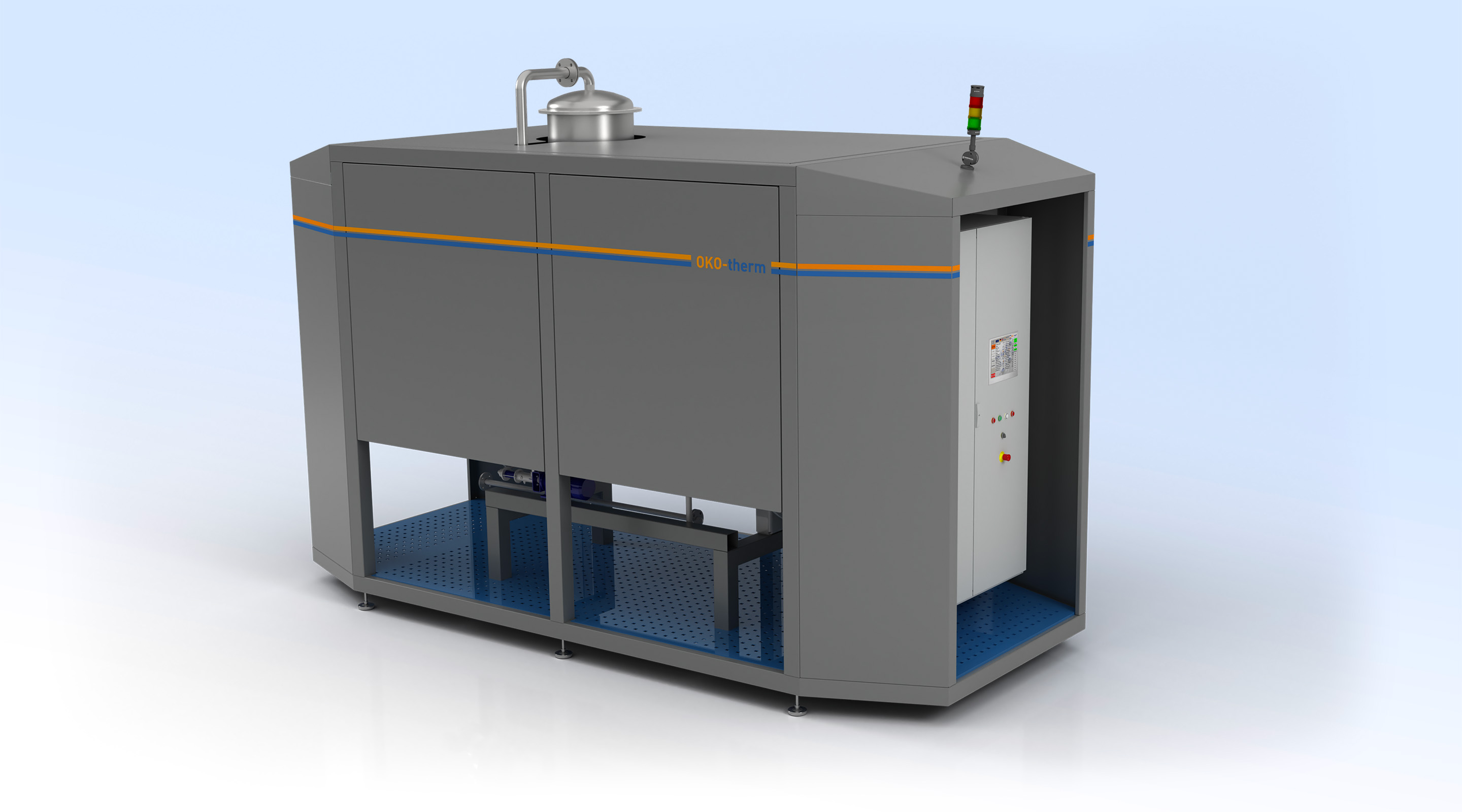
machine enclosure
Mechanical foam trap
Optional exhaust-air
collection and treatment
interface
maintenance module
Optional pre-treatment
by sludge trap, oil
separator or
neutralisation
Low cleaning costs
Benefits
- High distillation capacity
- Low concentrate quantities
- Efficient heat transfer for optimum energy utilisation
- Automatic dosing of defoamers, anti-corrosion chemicals, and cleaning chemicals
Which Industries Use Evaporators?
Evaporators can be used across a wide range of industries, from chemical processing to metalworking and mechanical engineering. They are frequently used for process water treatment, with the aim of producing demineralised water, also known as deionised water (DI water).
However, when planning such a system, it is important to consider that under certain conditions, more cost-effective technologies may be available for producing demineralised water.
What Needs to Be Considered When Using an Evaporator?
Evaporation can result in highly concentrated substances. Before an evaporator is selected and designed, several key factors should therefore be assessed.
Does the wastewater contain organic, water-vapour-volatile substances that may transfer into the distillate?
Such substances can increase hydrocarbon concentrations and COD/TOC levels in the distillate.
What is the salt content of the wastewater?
If salts are present, particularly halides such as chlorides, bromides, iodides and fluorides, the appropriate materials for the evaporator must be considered during the design stage. Salt content also limits the maximum achievable concentration factor.
Does the wastewater tend to foam?
Foam can cause damage to the connected compressor in evaporators equipped with vapour compression. Suitable and effective defoaming agents must therefore be selected during system design according to the characteristics of the wastewater being evaporated.
Does the wastewater contain substances with a flash point within the temperature range of the evaporation process?
The high surface temperature of the compressor in vacuum evaporators must be taken into account.
To what extent can the wastewater be evaporated or concentrated?
As a rule, the concentrate is discharged from the evaporator as a liquid phase. However, as the concentration increases, deposits can also accumulate in the evaporator and heat exchangers.
A balance must therefore be found between the maximum achievable concentration factor and an acceptable cleaning requirement.